The Three Stages in the Evolution of Food Production Throughout Human History
As climate change, environmental degradation, and global food security become increasingly urgent concerns, agriculture is no longer viewed simply as a means of producing enough food. Instead, it has become a central issue in long-term sustainable development. Consequently, terms such as traditional agriculture, modern agriculture, and sustainable agriculture now appear with growing frequency in policy reports, academic research, and public discourse.
However, these concepts are often used without a consistent framework for interpretation. When separated from their historical context and intended functions, different agricultural models can easily be misunderstood as representing “right” or “wrong” approaches, rather than as production systems that emerged to meet the needs and challenges of different stages of societal development.
This article aims to distinguish these three agricultural systems as analytical categories, helping readers to:
- Develop a clear understanding of the nature and characteristics of each agricultural model.
- Avoid common misconceptions and oversimplified interpretations.
- View them as successive stages in the continuous evolution of agricultural thought throughout human history.
Traditional Agriculture: The Foundation of Agricultural Civilization
Definition, Historical Origins, and Scope
Traditional agriculture is the earliest form of agricultural production, emerging as humans transitioned from hunting and gathering to settled farming communities. Historically, this transformation began approximately 10,000–12,000 years ago, independently across several regions of the world.
The major centers of traditional agriculture are commonly recognized as:
- The Nile River Valley (Northeast Africa)
- The Tigris–Euphrates River Basin (Mesopotamia)
- The Indus–Ganges River Basin (South Asia)
- The Yellow River–Yangtze River Basin (East Asia)
In addition to these major centers, Southeast Asia is widely recognized as one of the world’s ancient agricultural regions, particularly for the development of wet-rice civilization. Within this region, Vietnam—located in mainland Southeast Asia—developed its traditional farming systems around the Red River and Mekong River basins. Shaped by a tropical monsoon climate, traditional Vietnamese agriculture has long relied on wet-rice cultivation, intercropping, and generations of indigenous knowledge.
Traditional agriculture is therefore not unique to any single country; rather, it represents the predominant agricultural system of pre-industrial societies around the world.
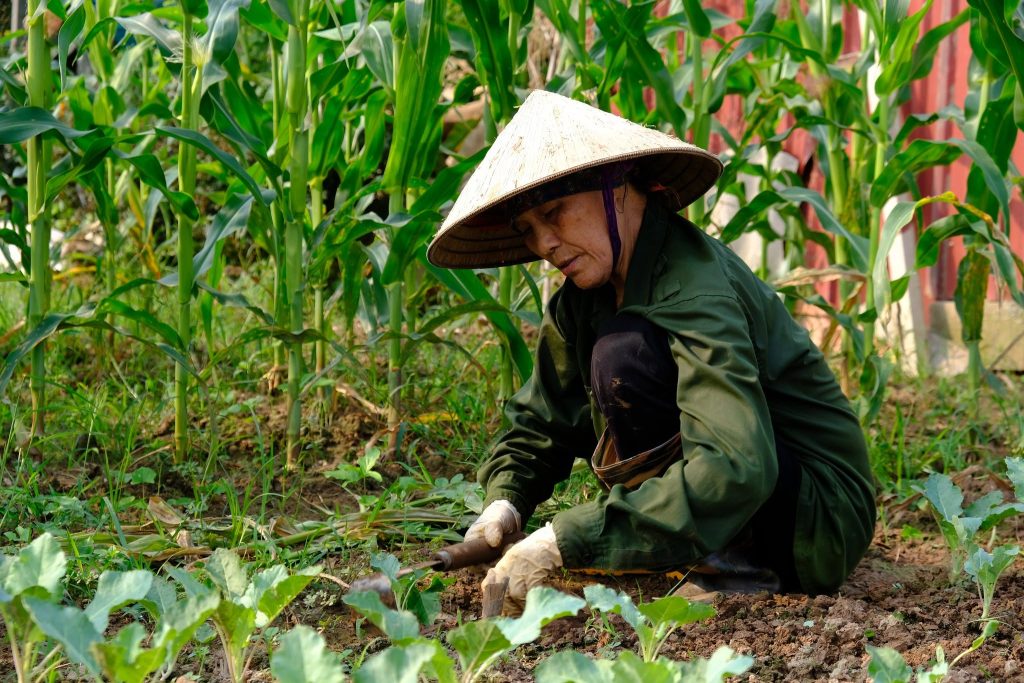
A Roots Journey farmer in Việt Hưng, Hanoi, manually weeding the fields.
Core Characteristics
Traditional agriculture can be identified by several key characteristics:
- Relies primarily on manual labor and natural sources of draft power.
- Agricultural knowledge is rooted in experience and indigenous traditions, passed down through generations.
- Farming practices are closely adapted to local ecological and environmental conditions.
- Production is typically small-scale, decentralized, and centered on households or local communities.
- The primary goal is to ensure stable livelihoods and the long-term continuity of agricultural production.
In this model, agriculture is deeply intertwined with social and cultural life. Seasonal farming cycles, festivals, culinary traditions, and community organization are all closely shaped by agricultural practices.
Common misconceptions about traditional agriculture
One common misconception is to equate traditional agriculture with low productivity and inefficiency. This perception often arises from direct comparisons with modern agricultural systems, while overlooking the historical context in which traditional agriculture developed.
To understand this, it is important to recognize that traditional agriculture developed under conditions such as:
- Significantly lower population levels compared to the present day.
- Limited availability of machinery, industrial fertilizers, and preservation technologies.
- A strong reliance on natural cycles and environmental conditions.
Within this context, traditional agricultural systems were not designed to maximize yield per unit of land, but rather to prioritize the stability and regenerative capacity of soil, water, and ecosystems. Therefore, labeling traditional agriculture as “low productivity” is only meaningful when compared with later-developed agricultural models; it does not fully reflect the original logic and operating principles of traditional farming systems.
2. Modern Agriculture: A Leap in Production Capacity During the 20th Century
Historic context
Modern agriculture emerged alongside the Industrial Revolution, beginning in the late 18th century and expanding rapidly throughout the 19th and 20th centuries. This period was marked by rapid global population growth, accelerating urbanization, and food demands that exceeded the capacity of traditional agricultural systems to supply.
Modern agriculture emerged to address a new challenge: producing enough food for a growing population, with stable yields and reasonable costs, within an increasingly industrialized society.
Key characteristics
- Applies mechanization, scientific advancements, and biotechnology in agricultural production.
- Uses improved crop varieties, fertilizers, and large-scale production inputs.
- Organizes production through value chains and market-oriented systems.
- Operates on a large, concentrated scale with a focus on high efficiency and productivity.
As a result, modern agriculture has made significant contributions to increasing global food production, reducing large-scale hunger, and providing a foundation for the development of modern societies.
Common debate about modern agriculture
Alongside these achievements, modern agriculture has also become the focus of numerous debates, particularly regarding environmental impacts and resource management.
Scientific reports indicate that agriculture and land use make significant contributions to global greenhouse gas emissions. According to international scientific assessments, the agriculture, forestry, and other land use (AFOLU) sector accounts for approximately 20–25% of total global greenhouse gas emissions, including emissions from crop production, livestock farming, and land-use changes.
It is important to recognize that these debates do not seek to dismiss modern agriculture entirely. Instead, they emphasize that certain forms of implementation—such as long-term monoculture, excessive reliance on chemical inputs, and unsustainable resource exploitation—may contribute to increased environmental risks. Differentiating between the underlying principles of the agricultural model and its specific applications is essential to avoid generalized or overly simplistic assessments of modern agriculture.
3. Sustainable Agriculture: A Future-Oriented Approach
Concept and Origins
Sustainable agriculture is a concept that emerged and gained widespread recognition in the late 20th century, closely associated with the development of sustainable development thinking in international frameworks and policy documents. The concept was directly influenced by the definition of sustainable development introduced in the Brundtland Report (1987) and was later incorporated into numerous publications and initiatives by international organizations such as the FAO, the United Nations, and global environmental and development agendas.
At its core, sustainable agriculture seeks to:
At its core, sustainable agriculture seeks to fulfill present food demands while safeguarding ecological systems and ensuring long-term livelihoods for producers, without undermining the capacity of future generations to satisfy their own needs.
Unlike the two previous models, sustainable agriculture is not simply a type of farming practice, but rather a set of principles for designing and managing agricultural systems.
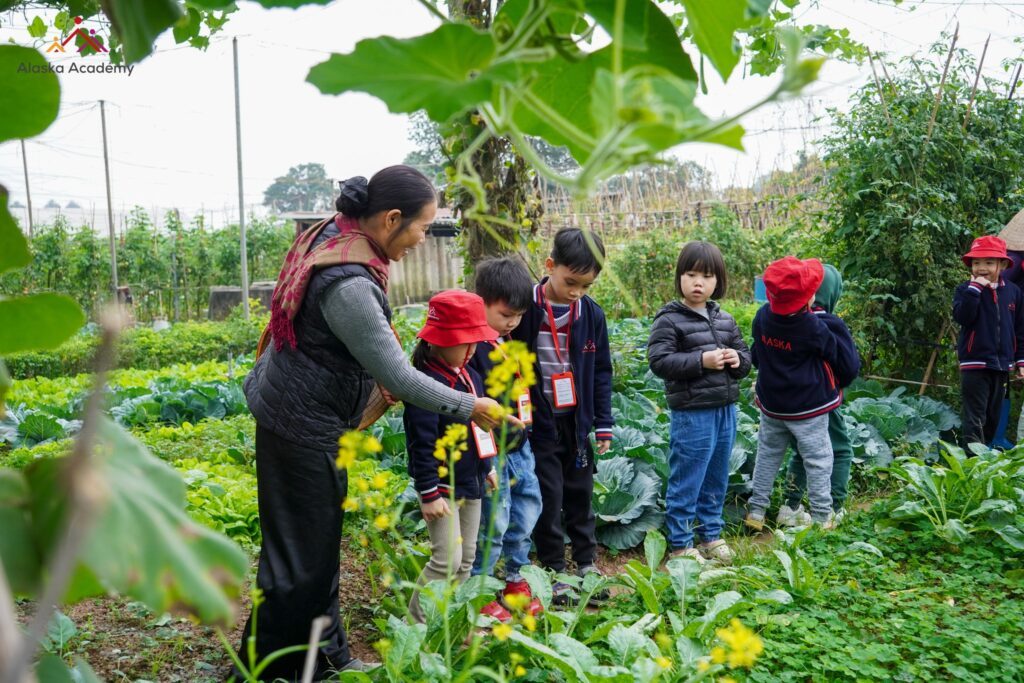
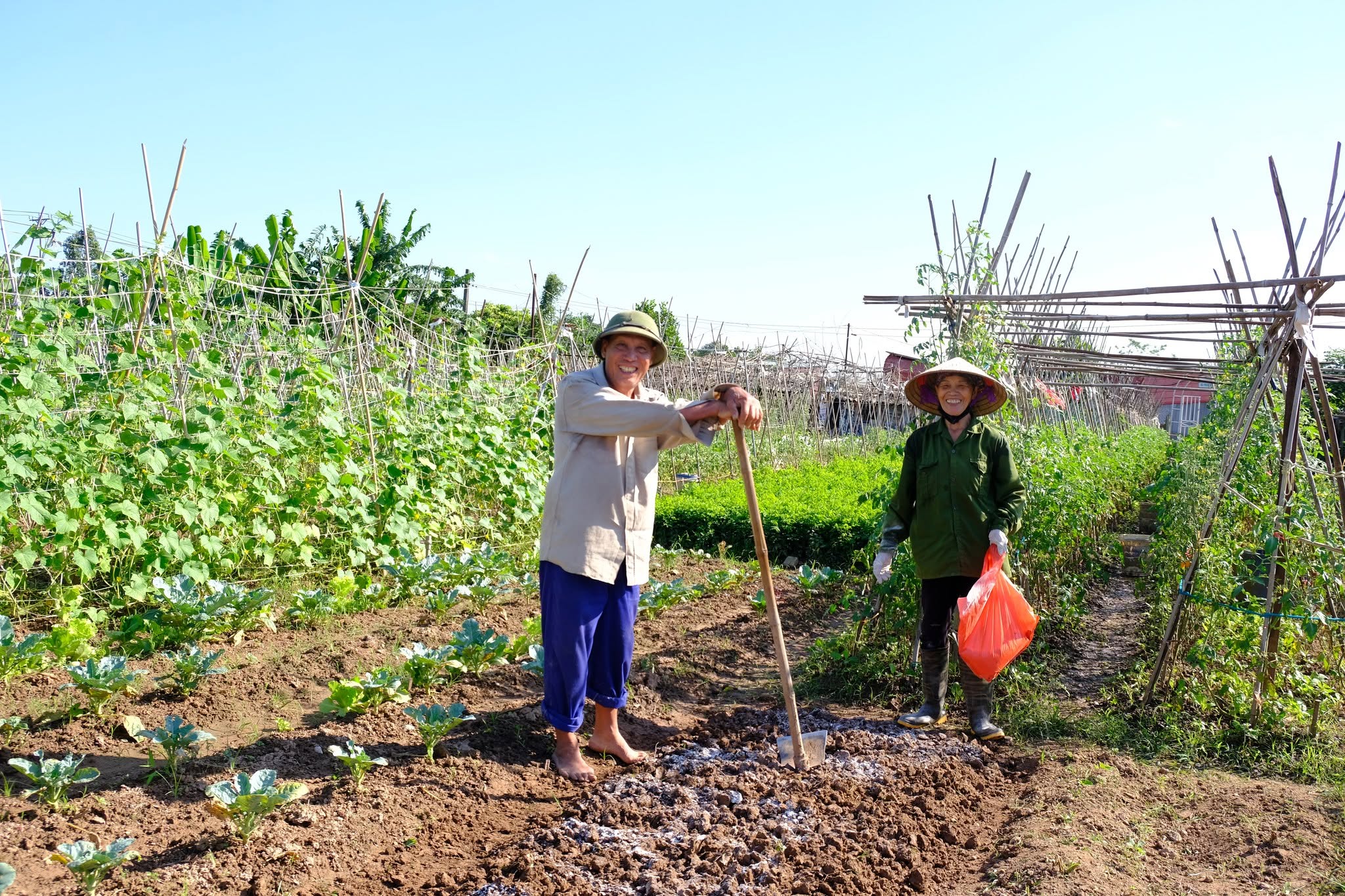
Agricultural experiential tourism has long served as a stable source of livelihood for many farming households in Viet Hung, Hanoi.
Relationship with Traditional and Modern Agriculture
Sustainable Agriculture:
- Inherits the ecological thinking and local adaptability of traditional agriculture
- while also building on the science, technology, and management approaches of modern agriculture.
Therefore, sustainability does not mean returning to the past, nor is it simply a compromise between different approaches. Instead, it represents a process of restructuring agricultural systems to reduce long-term risks.
Common Misconceptions About Sustainable Agriculture
As the concept of sustainable agriculture has become more widely recognized, simplified interpretations have also emerged. Among them, equating sustainable agriculture with organic farming is one of the most common misconceptions.
Organic farming is a specific agricultural practice that focuses on reducing or eliminating the use of synthetic chemical inputs. It is an important component of sustainable agriculture, but it does not encompass the entire concept of sustainability. Beyond organic practices, sustainable agriculture also includes soil and water management, biodiversity conservation, emission reduction, farmers’ livelihoods, and the resilience of agricultural systems in the face of climate change.
Distinguishing these concepts helps avoid the misconception that “simply practicing organic farming automatically means being sustainable,” or conversely, that “without organic practices, sustainability is impossible.”
Overview Comparison Table
| Criteria | Traditional Agriculture | Modern Agriculture | Sustainable Agriculture |
|---|---|---|---|
| Period of Formation | Pre-industrial period | 18th–20th centuries | Late 20th century |
| Primary Goal | Livelihood stability | Increased production and efficiency | Long-term stability |
| Knowledge Foundation | Indigenous experience and traditional knowledge | Science and technology | Science combined with ecological principles |
| Relationship with Nature | Adaptation to natural conditions | Intensive intervention | Ecosystem management |
| Scale | Small-scale, decentralized | Large-scale, concentrated | Flexible and adaptive |
| Main Risks | Vulnerability to natural fluctuations | Environmental degradation if applied excessively | Difficult to implement without appropriate systemic conditions |
Conclusion
Traditional agriculture, modern agriculture, and sustainable agriculture should not be viewed as three mutually exclusive choices. Rather, they represent three stages in the evolution of humanity’s approach to food production throughout history. Each model emerged to address different challenges under different social, environmental, and economic conditions.
The purpose of distinguishing these three concepts is not to identify a single “correct” model, but to provide a foundation for more meaningful discussions about agricultural transformation in the future: where, under what conditions, and toward which goals. By accurately defining and understanding these concepts, we can design appropriate solutions instead of engaging in debates shaped by assumptions and misconceptions.